You're watching...

New Documentary Takes on the Nuclear Power Industry

Details

  • Description

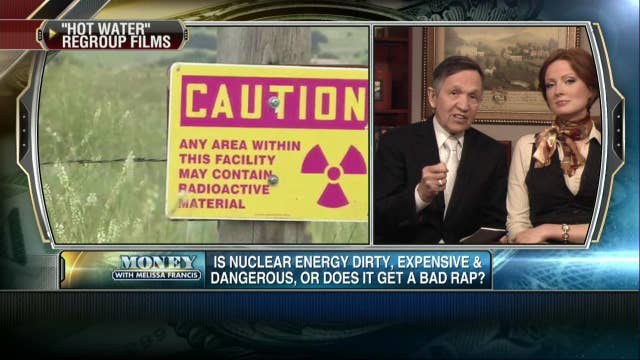
    Former Rep. Dennis Kucinich, (D-Ohio), and “Hot Water” Executive Producer Elizabeth Kucinich on the dangers and waste of nuclear energy discussed ...

  • Duration 5:56
  • Date

Clips

Also in this playlist...

Latest Video

Auto-advance: ON

Auto-advance

Transcript

This transcript is automatically generated

-- -- a new documentary called hot water gives insight into a pretty hot issue in our country today nuclear power.

Pretty executive producer Elizabeth percentage takes viewers.

Through the ins and outs of the controversial energy -- critics slam it for being dirty unsafe and expensive.

But is nuclear power getting a bad rap.

Here on money we give viewers all the facts are joining me now.

That along with her husband former congressman Fox News contributor Dennis Kucinich thanks to both of you bird joining us.

Elizabeth battered if you want to take -- the why did you guys decide to do this.

This this is Dana passion about one of my best friends it is lunges -- has been traveling around the United States and really on the discovery.

As she she started doing actually document she -- on sacred ground.

And while she was dead she founded and populations that have just been ravaged by -- And she found out that the reason why they've been ravaged by cancer is because it should they -- speak it is hard.

That's happened in the world to this coming out in now homes from their wells is contaminated -- with such high levels of radioactive particles from.

A mining -- uranium mining for the need to -- industry.

That she decided to actually make an entire film about -- so I'm I have seen them -- they've had to make this film happen and very happy to say that opinion this week at the environmental film festival and -- -- today's Citi.

So -- the real point is is that you know these are uranium mines that have that are no longer being used and that contaminated.

Ground water nearby or why is this an issue that we don't generally talk about.

Well it's a public health issue because.

If water supplies are being contaminated.

From either past or present uranium mining.

If water supplies have been contaminated a pass from nuclear explosions that went underground and fractured.

That Iraq in the end and then radiate radioactivity went into.

Into the underground water -- -- -- -- public health issue so.

It's important now.

Because they're one of the things and -- Rogers in their pictures she did readings.

Of -- Colorado River -- you -- where the radiation was 16100 times the level.

-- of background radiation and that's.

A rate that's the radiation -- the water.

-- -- warning you you're talking about a particular place where where there is a particular problem that the Department of Energy has in fact recognized.

And they put in place to clean up deadline of 2019 -- party started removing.

Four million tonnes have been removed about a fourth of it I advocates -- watching -- about a fourth of of the contamination.

So wide you need to bring do you think more awareness is something that -- in acknowledged in -- cleaning up.

Well they said that in one area that you're showing -- -- Every day millions of gallons afford to go through these piles in a going into the rivers in the -- -- seven seeing millions of people across the southern states than the United States so this isn't just a contained issue what actual.

This is just let's just one of the size now -- and their thousands of sites.

Often down the country and the cleanup costs a -- -- billion dollars a year for each of these sites and when -- told -- about -- this is an extraordinary.

Issue but is not -- on mines that have already.

Being -- this is about this is an issue about mine claims and the issue about -- NC Chile's mining which is happening every day across the United States.

And whenever -- -- about them the mining that's taking out the uranium material in this crisis and they say couldn't -- Cheney's mining.

That there's the idea that well is it contained clay sleep system.

But what this documents -- -- uncovers is that it's not that they it's -- -- large bodies of -- don't we talk about the Angela aquifer for example.

That stops in North Dakota triggers -- seven states and goes to Texas.

That's an enormous number of people who.

-- -- -- -- let's ask that you want to do and I don't wanna interrupt -- just wanna make sure we get through all the material is that you want to see more places testing water.

For uranium.

And radiation and in fact we see that happening right now Nebraska New Jersey but not now a lot of other place.

Well we need to have you know really good conversation about our energy policy in the United States sent a lot of people are discussing and saying well nuclear energy is the energy of the -- that.

That it's green and clean and it doesn't contribute to climate change well.

And yet it might not contribute to climate change but it is by no means grain and it's not plane an absolutely is not healthy I want to -- she does -- it it really shows.

The extraordinary health effects that have ravaged communities.

And you know when you know because they affect how -- As a way to do this more responsibly -- -- what we're talking about.

Are things that we're now going back in cleaning up near these uranium mines or mean could this be done -- responsibly in the future does -- mean we have to get rid of nuclear energy.

I'm the did there's the -- really doesn't draw conclusions.

Finally about nuclear energy dim view -- can -- their own conclusions okay at this at its inception.

They uranium mining has.

-- -- it has radioactive contamination.

Of water supplies as one of its output at the end of the line when your uranium is in process and end users and and this fuel is spent.

There's no place to store their -- it's not safe -- -- DR as a threat to water supplies over the country so this is -- an energy source.

Which has not led to -- its going to be too cheap to meter has environmental consequences.

And help while the film itself is all about getting rid of nuclear power it does raise the health issues the public -- shares of the -- -- line.

In this country about what we have to do with the waste and brands they recycle it being here we're trying it -- in this country were still trying to figure out what to deal.

A lot of issues here unfortunately we're out of time but we're gonna check out the movie of Dennis and Elizabeth -- hot water thank you for coming on.

Thank you -- you we've --