You're watching...
Is Health-Care Law a Roadblock to Budget Agreement?
Details
-
Description
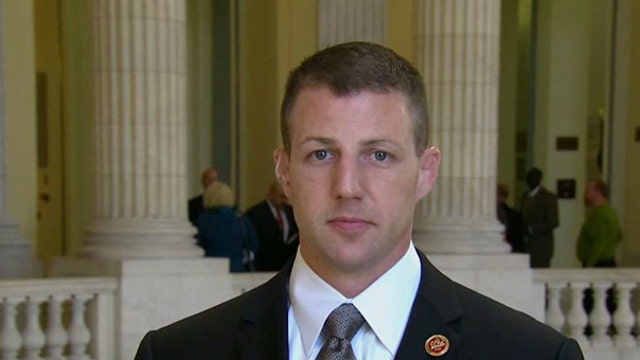
Rep. Markwayne Mullin, (R-Okla.), on efforts to reach a compromise in the budget talks.
- Duration 4:31
- Date Mar 12, 2013
You're watching...
Rep. Markwayne Mullin, (R-Okla.), on efforts to reach a compromise in the budget talks.
Also in this playlist...
Auto-advance: ON
Auto-advanceThis transcript is automatically generated
Freshman congressman mark -- -- appealed for bipartisanship in his speech.
On the floor of the house last week.
Mister speaker come to you today not as Republican or Democrat but an American committed to the United States constitution.
-- regularly hear from my constituents are fed up of the -- and fighting.
We pledge allegiance to the United States of America not.
Our political parties.
-- in congress really come together this trying to get a budget deal done representative -- is a Republican from up.
He joins me from Capitol Hill right now how did that go over by the way congressman.
It went great do we had immediately we walked out before we had people on both sides come into us and and at Telus -- on I appreciate you taking a stance that way in.
And really act as a whole the membership I felt like we are coming together now granted -- -- very optimistic individual.
My glass is always half full.
But I believe if if we are truly willing to put country first and -- party second.
We have an opportunity to get this country back on track and I try to remind people it has nothing to do it thus far reelection this that's do with our kids and our great kids.
And it's our responsibility to make sure we give -- something better than what was handed us.
You feel like that's what's happening in this current budget process because Lou Dobbs is on here a short time ago saying that.
By virtue of putting forward the budget that we have right now in saying that you know it depends on obamacare being repealed.
So that you know is it really a step forward with Democrats in -- in enough itself is such -- non starter.
Well the most important thing is is that we have to be able to get our spinning out of control he heard the White House come out and say that.
Their budget isn't -- -- balance you hear the senate not giving we end or if they ever of their budgets on a balanced.
And it's because they're looking at obamacare and realizing this country can't afford it that we can't simply go out there and do something we don't even know what the cost is look are spinning out of control right now.
And if we ample -- Obama care.
It's gonna bankrupt us who were right on the virgin literally I felt like -- on the tipping balance are going to borrow over.
And not -- bring this country back into stability both -- and went.
We're not mathematically.
That's true and certainly it makes sense yeah.
There it it seems like there's no way to get Democrats to agree that that I mean especially the president this is his signature legislation.
Well and -- -- at what I'm talking about with the members the members.
There are talking about this they understand one thing that really sides Alcan agree yes and one thing that both sides Alcan agree is it that we have to gets -- control.
Sometimes the leadership.
May be -- it baby's not agreeing about the members themselves.
It when our conversations are private conversations we understand that we have a responsibility in front of us and if the country can't afford it at this time.
It is time to look at something that -- and what Paul Ryan's budget did do is -- that something else in place.
And if he had the opportunity look at it you're allies look we're not just totally butting our punk scene national health care down -- -- saying yes let's but it was something that will actually work.
That this country can't afford that'll take care though those individuals that we really wanna take care -- Congressman you also look at some other common sense things for example I -- you look at the sequestration the 85 billion dollars there.
And you point to the fact of the federal government -- 150 billion in improper payments.
To people who weren't entitled to receive never had provided the documentation.
What does that specifically and how to back over.
Well.
You -- as a business owner that I've I've dealt with balancing the -- -- -- checkbook every it'll literally every month we have eight eight companies are multimillion dollar companies.
In -- no -- you can tell what you paid something improper urge you cannot get -- are working for a and so that so the government -- N 2000 let -- than a 115 billion dollars in improper payments a 108 billion dollars in 2012.
It is continued down that same track and are not willing to address it because it's.
Either one it's not politically.
Reasonable for them today it.
Or they get simply want to turn the -- and point fingers at someone else.
-- and that's what I consider a lack of leadership on the need for improper payments to individuals that had no business receiving and either they were here -- legally.
Or they didn't -- the paperwork properly.
Annika in the country still cut needs individuals -- -- you tell me anybody out there you're Republican or Democrat that thinks that's a good idea.
I have a lot of destruction of the X -- -- one more at a time C have to come back soon OK congressman I would appreciate that thank you for your time ratio.