You're watching...
High Yield Bonds: How Pricey is the Investment?
Details
-
Description
BlackRock managing director Jim Keenan makes a case for adding risk to your portfolio.
- Duration 4:34
- Date Mar 12, 2013
You're watching...
BlackRock managing director Jim Keenan makes a case for adding risk to your portfolio.
Also in this playlist...
Auto-advance: ON
Auto-advanceThis transcript is automatically generated
Thank and -- thanks Nicole the markets continuing debate hit new all time high but one of the biggest concerns for investors.
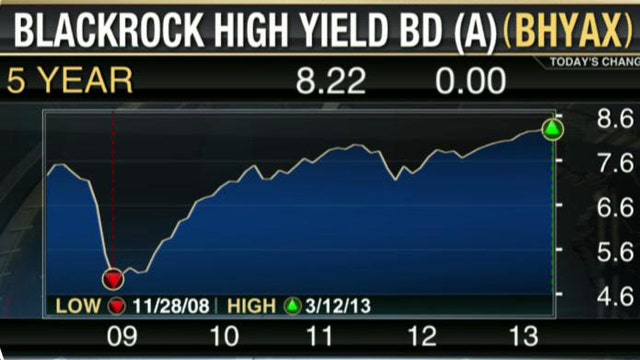
High yield bonds how pricey are these investments should you be worried if -- Offers guests today with -- forty billion herself -- management mostly in high yield Tim -- and head of leveraged finance stand down.
High yield at BlackRock and he's here -- studio it's good to see you thank you coming and sell them stock market -- have this advanced to.
To a record in lot of people are stuck in the or thin metal stocks right word the opposite of high yield very low yielding assets make the case for risk today -- can force.
I think it's what.
Types of risks you want to own in this economic environment and -- we've been dealing for the last five years of everybody signed.
How do you protect your money down and you did that because the probabilities of that deflation of that recession outcome was real.
Central banks around the world in fiscal governments have continued to evolve their policy and have.
So I think what you're seeing now is more people trying to say well what do I do with my monitor -- protect that or how to -- Bill to create value.
So you're seeing more more people move out of some of these longer duration fixed income masses that are yielding zero if your cash or even 2% for ten year treasuries.
And going into high -- -- going into equities at this point.
And that's because you're saying indeed the UK economy is more likely to have a stable slow growth outcome there's still a lot of leverage and that's a headwind but stable growth allows people invest.
-- how expensive broadly as high yield compared to treasuries looking back historically even just the last twenty years of south yet.
-- members yields are low but yields are really being determined by low inflation expectations as well as -- economic growth and that's the reality of deleveraging.
The spread over that US treasury for a high yield is still around 500 over.
If you thought about -- relative value terms that spread level over the five year treasury historically it's been about a 160%.
That yields.
But today is still talking about 6% for high yield -- ninety basis points for the five year treasury just think you -- you're talking that there are a lot of just normal people out -- saving for retirement or in that situation where they're gonna have to make some sort of the transition right out of the the treasury market to whatever it is the lower yielding assets -- talked about a moment ago into something else so I don't think it make this comparison but if they're saying.
We're going to stocks -- -- go to some sort of fund that invests in high yields.
What's -- their thought process they -- what would you community case for high yield over stock sale or.
Yeah I think I mean we how.
Every investor's portfolio should be positioned should really be based on where they are -- if it's a consumer.
When they are in their retirement cycle what's the what are they trying to achieve with a portfolio of a question of price today can -- -- -- yet so.
Fixed income as a whole has less volatility than -- -- and even think about high yield bonds it is lending to a corporation so the health of -- corporation matters you know in your senior in the capital structure to the equity.
So the overall the volatility of cash flows has a bigger impact on the equity.
So when you looked over and high yield -- senior in the capital structure so we give up some of the upside to get some downside protection.
-- but did are you worried though about -- an entire class of investor invested in high yield today.
Who have never really experienced losses in fixed and -- -- -- you've had a thirty year bull market.
In treasuries and it end broadly speaking in fixing comp because interest rates have been -- Yet this investor in there he doesn't think that they can lose -- -- On these investments and made me sit in a big fall on the -- ended freaked out.
-- -- housing market comparisons of the you know moment adequate it was money announcing her I'd -- -- Yeah I don't have that they can make fixing common they'd say thanks safe -- so they're very different ranges of fixed income I think high yield has been perceived as a much riskier asset class and other fixed income certainly -- the US treasury -- If you think about owning long duration US treasuries a long duration investment grade corporates I mean.
People aren't looking that as default risk and invest in high yield bond they look at what's the probability of default and you're expected recoveries so high yield has been a more volatile asset class.
So I do think that when investors are looking at there other overall fixed income portfolios they have to think about what types of risk they want -- -- now duration.
-- -- has been a good outcome in any downside or -- recession type environment but in an environment might we see today.
We seeing more stabilize in a very accommodative policy from the Fed.
Then what thirty a Wal-Mart risk is not a default risk but you can see the treasury curve back up or steepen.
In which case you might -- principal loss not income ones off to -- conversation we could talk for even longer but their what time constraints that -- -- educated BlackRock and none of it -- thanks a lot thank you.