You're watching...

The Economic Benefits of Tax Reform

Details

  • Description

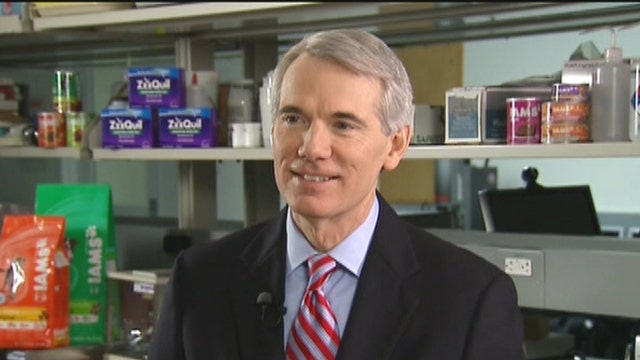
    Sen. Rob Portman, (R-Ohio), on the benefits of reforming the U.S. tax code.

  • Duration 13:48
  • Date

Clips

Also in this playlist...

Latest Video

Auto-advance: ON

Auto-advance

Transcript

This transcript is automatically generated

On good morning here we are -- the Cincinnati area -- at eight Procter & Gamble research facility with the Ohio senator senator Rob Portman is joining us.

For a lengthy conversation on tax reform thanks so much for joining -- thanks for having me on so we'll start out with a comment that speaker Boehner recently made questioning whether tax reform.

Should be done and what he's calling a hostile.

Political environment do you believe in your conversations.

With the administration you've had conversations with secretary Tim Geithner when he was secretary.

You've had both private and public conversations with Jack -- Do you believe the administration is willing and are we getting an improvement or are you seeing an improvement with Jack Lew over Geithner.

Well.

I do think that the environment is conducive to tax reform I mean look it's one of the few things that we can do -- Republicans and Democrats alike to get the economy a shot in the arm.

I did raise it during the Jack -- confirmation hearings and the response I got was positive saying yes administration disinterested.

In tax reform that actually runs a base of taxation lowers the rate.

And therefore -- some more economically efficient tax system that'll help create jobs in America do you feel as you've had a willing partner and secretary Geithner.

Well I mean he talked about a lot but you know frankly the administration wasn't willing to put forward -- plan I was on the super committee you know so called for -- death be not so super.

In part because we didn't get tax reform done and during that time we did we work with the administration some.

But frankly don't think they were ready to do it I don't think they're willing to take it on in the first term.

Now we have a different situation we -- had an administration that's talking about doing it but we also have chairman of the tax writing committee in the house Dave Camp the Ways and Means Committee and the tax writing committee chair of the Senate Finance Committee Max Baucus.

Who said this is a top priority there's they've actually established a process to work through tax reform including a lot of hearings working groups and so on so.

I think the timing be right for us to do what we.

Did about 27 years ago and -- every 27 years is probably good idea kind of clean -- the closet and a clean up the tax code.

There have been literally hundreds of new tax preferences of loopholes added to the code since 1986 last time we did this it's time to do it again.

But senator baucus chairman baucus the ranking member senator hatch RNA anywhere near coming -- -- -- proposal we know chairman camp is already beginning to put.

Planning on paper money out there we haven't quite seen that and the senate again.

They're talking and senator hatch we say is the ranking Republican on the finance committee is also extremely interest that I've had a lot of great conversations with him.

Got a terrific staff who -- already worked a lot of these issues actually work with them -- -- -- -- -- -- on -- -- -- -- tax -- -- We actually put forward within the joint committee on taxation which is the score keeper in congress to corporate tax reform proposal.

So I think there's there's a lot of communication going on and I think you know both of those senators have a lot of experience you know how to work through tough issues and they're -- going to take it on.

-- reportedly that that you -- your.

Proposal that you worked on super committee you would consider releasing it if you had a willing democratic partner in the senate.

Are you talking with any senate Democrats now.

I am in fact there -- 45 Democrats in the senate who have expressed some interest.

None of them at that level of interest willing to put out a specific plan and but you know that may not be the best we saw it anyway.

Well you know you you can imagine the list I mean senate Democrats on the finance committee primarily.

And you know they they -- realize what we realize which is that the current tax code is inefficient.

It's antiquated it's -- a date it's bad for jobs incredibly -- complicated really difficult for citizens and US companies to comply with.

Time to fix it and you know the question is how you do it and specifically which of the preferences.

To either cap.

Or eliminate altogether this was the debate back in 1986 last time we get it.

But it's a process worth going through and it's a fight -- happen.

Because at the end of the day if he had a simpler.

More economically efficient tax code you're gonna see more jobs in America that's what happened in the late eighties it helped usher in a period of prosperity in the late eighty's and ninety's.

Under Ronald Reagan and Bill Clinton thanks to the tax reform that was done on a bipartisan basis Simpson Bowles is now come out with a new proposal an update of their previous proposals.

Saying that you can get 600 billion dollars of revenue from tax reform not to lower rates just to put towards reducing the deficit.

I don't know -- well I think what's -- is that from the start is that tax reform should be part of the plan.

They have made the point that I just made that its pro growth that it's gonna result in more revenue coming into the federal government.

They would also like to see some tax increases.

My feeling is that we had to do it on a tax neutral basis in other words -- -- be revenue neutral.

It will generate growth it will generate income.

Every study that's been done by the joint committee on taxation which is a nonpartisan group -- -- Capitol Hill.

-- by the Congressional Budget Office but also by outside groups indicates that if you did the kind of pro growth tax reform we're talking about you will generate more revenue.

But -- get it the way of course everyone wants to get it which is not by hurting the economy.

Predictive -- small businesses most of whom pay their taxes as individuals.

But rather through growth.

So that ought to be our objective.

Look at the code.

From a fresh perspective say you know which of these preferences and loopholes is is appropriate which we ought to ought to go.

They come up with a tax reform that doesn't cut taxes.

Get at a lower rates but only because you're getting rid of a lot of the preferences and loopholes but instead president revenue neutral way and then generates.

More revenue through more growth and economy that the most specific or most problematic -- -- right now is that you have Democrats who want to.

Gaining revenue strictly and and is exploring way from tax -- Well some do and some don't mean others as you know talked about revenue from other sources and a sensible thoughts about presents some kind of energy tax or gas tax which -- -- one way that they get their revenue.

I will say that congress -- just reform the tax code.

In a sense raise taxes by 620 million dollars so you know only -- -- an exact opposite you've narrowed the base and exactly and you exactly.

So it absolutely.

We've we've we've we've done the tax increases again about 620 billion dollars over ten years.

Primarily at the top -- and therefore getting a lot of small businesses.

-- it's an opportunity to say okay.

This is the code we have which has become a monstrosity in terms of the size and complexity.

It's about ten times longer in the Bible and not nearly as -- -- as I -- yesterday at a speech.

Now some opportunity for us let's not talk about tax increases or tax.

Cuts let's talk about instead how do you get the tax code to work better for American workers and this is about workers.

There is a study done by the Congressional Budget Office with regard -- the corporate tax system.

70%.

For the harm done by the higher corporate rates that we have is borne by workers.

And it -- in the in the form of lower salaries fewer benefits.

Fewer job opportunities.

So if we -- -- be competitive globally if we want American workers to be able to compete on a level playing field.

We -- reform our tax code and I think there's a broad consensus about that when you look at some of the proposals out there you had a top rated.

45%.

Chairman Dave Camp at a top -- point 5%.

The ranking Democrat on the house Ways and Means Committee said that the top rate eliminating every tax rate.

Does not achieve 25%.

And revenue neutrality have you work but the joint committee on taxation.

Have you found a way to.

Make sure that you can -- this revenue neutral get to 25% and maintain any tax deduction.

Yes.

Answers yes.

And I think what congressman Levin was talking about another congressman Levin has also for tax reform who is the ranking Democrat on the house Ways and Means Committee.

Again there -- different visions of how -- tax reform.

Might end up but everybody seems to be saying look there is a way we can do this to make the economy grow and to make them more -- more efficient tax code.

But I think he was referring to a study that was done by the joint committee on taxation I think it is request but it didn't include all the preferences.

And I -- just assure you that it can be done because it has been no equity keep.

That's that's the -- quite well we've been asking.

We elders ask people with tax proposals and he never identify what stays and what goes what stays with us that's the that the devil's in the details as as they say it and and it does you know.

Involve the congress taking some tough decisions but the decisions that we did in 1986 we should do them again and by the with regard to a 25% rate.

It also deals with the international tax system that right now is not competitive.

It can be done because we have a proposal that is -- and -- very specific and it deals with both the domestic side -- -- 5% rate.

-- the bottom of -- -- the -- -- for the corporate tax system but also has a new international system.

That is comparable to that of our trading partners -- I don't does the international component work and is it is it are we discussing straight.

International.

Worldwide system vs a territorial system or will the definition become -- how do you make sure that on paper.

One company doesn't transfer billions of dollars of wealth to Ireland and say well that's where that's going to be taxed now at a much lower rate.

And we get nothing in the United States how do you protect against that or do you protect against that.

No I think he should protect against it and that I know you can't because other countries have done it -- in our tax reform proposal that we have scored by the joint committee on taxation does that.

I think that German camps proposals.

Are very interesting in that regard.

And I know that senator baucus and senator hatch also have some similar ideas -- -- -- on.

Let me back up for second cover what this is so important we're sitting here at the Procter gamble company's Cincinnati Ohio.

And this is a pleasure to do the research.

Not just for the US market but for the global market so -- is a good example of a fortune 500 company in America that makes most of its revenue overseas.

So increasingly US companies big companies here in America headquartered here.

Find it took in emerging markets and they're able to create a lot of revenue which helps us here in America for instance proper.

Which is the biggest employer in my hometown of Cincinnati Ohio.

About 40% of their employees here.

Support their international sales including the folks who make these products behind us here and it is of R&D right here in this building for the global market.

So out of the thirteen 1500 employees roughly about 5000 on -- -- international sales.

That's good for us here in America we want those jobs here.

But what these companies are telling us and they're also frankly showing us because we're losing a lot of corporate headquarters if they can't compete globally because these other countries.

At a tax code that's more competitive.

So they're competing against companies from Europe companies from China companies from Latin America.

That have a better tax system should be able to compete.

Globally.

So we've got to get our act together you know we haven't really reformed international side and fifty years -- -- -- this year can it be accomplished absolutely can it can and will it.

I think it will and I'm not I'm an optimist I I acknowledge that look I mean.

They're so few things where I can see it's coming together to find common ground in Washington right now.

I think both sides ought to be looking for ways to come together I think the American people demand it.

I think our economy desserts that are workers won it -- in -- deserve it which -- them a better economy more job opportunities -- take home pay.

And one way to do it -- through tax reform on the international side for instance if we did have a global system.

You would see a lot more headquarters staying here you see a lot more companies being able to compete globally in creating jobs here in America that's the key.

And there are ways you can put in place.

It's a very common sense provisions to avoid people.

Taking income may -- in taxing and and a look at look at jurisdiction overseas and those safeguards -- in place in other countries like France.

Like the UK like Japan.

All companies that compete with us.

All the whose companies are out -- -- competing with us every day.

So that -- are there ways to do this America is frankly fallen behind we have -- reform the tax code and 27 years.

In the interim every single one of our competitors.

Obnoxious lower their tax rates they -- their tax -- we've been on the sidelines of the Cyprus to get back in the game of like to get your response to.

The quote from congressman John -- what's in a letter him he writes the congressional leadership -- -- right to urge you to immediately reconvene super committee.

What do you think and act and idea.

It was a painful experience.

Look I I took it seriously I thought it was for real.

I think -- a few problems -- one short timeframe.

Second frankly the president was not providing that coverage support that he should have actually issued a veto threat.

Even before we -- -- for serious meeting on you know possible outcomes.

I don't like the super committee that's sort of way to do it I think the way to do it.

-- to have with -- call regular order meaning of the committees of congress doing the work they ought to do.

Having -- leadership in congress and having the president supporting the effort.

Frankly providing the political support cover that members of congress are gonna need to take -- tough decisions.

It has to involve both tax reform in my view and reform of our important entitlement programs these are.

Incredibly important programs like Medicare Medicaid Social Security but they're not sustainable -- -- current form.

And we have to be sure that we are strengthening them and preserving them for the future which we can do.

But -- -- require everybody working together and not making it into -- partisan political fight.

Senator Portman thank you very much you rich -- -- -- thank you very much in lengthy discussion with senator Portman.

Here from the Cincinnati area in Ohio -- -- Procter & Gamble research facility.