You're watching...

CBO: 2013 Budget Deficit Estimated at $845B

Details

  • Description

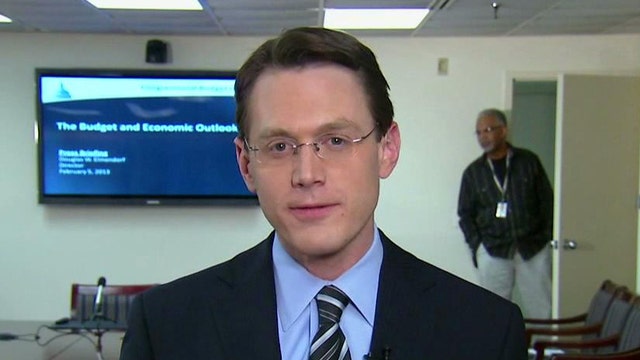
    FBN's Rich Edson breaks down the CBO's outlook for the economy and budget.

  • Duration 3:16
  • Date

Clips

Also in this playlist...

Markets Now

Auto-advance: ON

Auto-advance

Transcript

This transcript is automatically generated

-- Some breaking news the Congressional Budget Office releasing the latest version of its annual budget -- -- glimpse as to what we can expect our deficit to be.

Rich -- is in the Congressional Budget Office with all the details -- 845.

Billion dollars for this year this is the first time in five years the federal government.

We'll have a budget deficit of less than one trillion dollars let's take a look at the next ten years here 616.

Billion dollars deficit.

In 2014 in 2015 at 430.

For 76 and it starts to climb up again -- health care costs rising health care costs more retirees the aging of the population.

And interest payments begin hitting the budget even harder all the way to 798854.

All the way.

220 to 43 and 978.

Billion dollars that ten year period nearly seven trillion dollars added to the national debt and the national debt in total is projected to be.

26.

Trillion dollars by the year 20/20 three let's take a look at economic growth here.

The projections for this year one point 4% by next year and increasing growth of 3.4 percent.

Then from 2015 U 2018 and average of three point 6%.

And 20192023.

At 2.2 percent as for the unemployment rate.

8% average of this year or next year seven point 6% that would be six consecutive years of unemployment.

Of more than seven and a half percent the longest such run.

In seven.

Years as for the debt held by the public that's expected to stay above 73%.

Basically the entire decade upcoming.

Little information on how much the yet TARP program that bank bailout -- cost federal government 22.

Billion dollars in those automatic spending cuts that would talk so much about 85 billion dollars are supposed to hit the federal budget.

This year on March 4 march 1 on doing that will add one and a quarter percent.

To GDP -- this is the first what's known as the baseline scenario first look.

The Congressional Budget Office has had.

With permanent tax rates remember all the times the bush tax rates were supposed to expire -- those rates now that we're operating under our -- this is probably the best look the Congressional Budget Office the most honest look we've gotten from CBO.

-- years now want to show you one more thing -- here.

Deficit reduction this is CBOs three scenarios on deficit reduction.

If you increase deficits by two trillion dollars get a little bumping growth right there long term though by twenty -- 43.

He start to slow down if you had no deficit reduction -- decreased deficits by two trillion dollars over ten years.

You have a little short term slowdown but look how much growth increases here let's -- decreased deficits by four trillion dollars she take -- -- a short term hit.

For next year.

But in the long term you're adding almost two percentage points to GDP if you reduce deficits by four trillion dollars.

Over ten years we got our graph from the Congressional Budget Office where else -- -- Open rich I mean that was just about as helpful visual as you can get when it comes to understanding this math.

Big numbers complicated figures lot of factors to work again but that really breaks down that's an argument that everyone always has you know what is the cost of reducing the deficit you -- in the long run it's what we need to do to grow the economy if only we had done that before we see an economy that's growing now -- great report from rich that's absolutely troubling though.