You're watching...

A Not-So-Dire Debt Crisis

Details

  • Description

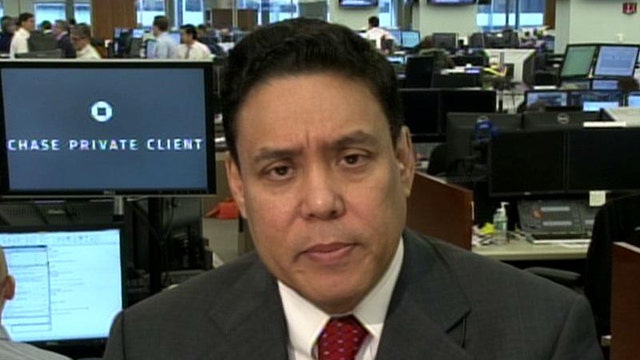
    Chase private client chief economist Anthony Chan weighs in on national debt and the jobs report.

  • Duration 4:20
  • Date

Clips

Also in this playlist...

Latest Video

Auto-advance: ON

Auto-advance

Transcript

This transcript is automatically generated

Ninety Nicole now the debt crisis in this country that you hear so much about it might not be as dire as we originally thought -- experts don't even think it's our.

Nation's biggest economic problem Anthony Chan joins us chief economist attention private client group and there's a big headline in the Los Angeles Times this morning -- US debt.

Worries are not so dire putting a number of experts I'm I'm sure we could dial up I guess it.

And a heartbeat -- months -- screaming about that is about people going on for years about how big deal but hey maybe -- something to that we've been.

Making too much of -- were really making progress that hasn't been reported what's your take Anthony.

Well I think we are making progress I certainly think that both Democrats and Republicans have shown at least some willingness to get a little serious on this issue.

And over the near term I think of the progress continues we don't have a serious issue -- longer term as America is aging.

And you have all those unfunded.

Pensions and you have the big bulge in health care spending and things of that nature I think we do have to.

Buckle down and and certainly continuing not give -- -- The excitement of trying to -- these deficit.

-- so let's talk about this in ostensibly as we -- argument basically is you have 2.4 trillion dollars.

It that's already been cut into the projected deficit over the course of a ten years that's what I mean by the idea that progress is being made.

And that means the problem is not as you say tomorrow's problem but what is -- a reasonable timetable for when.

The deficit and the debt are big big problem is it five years ten years twenty years what is it -- your view.

I think in my view is as far as the eye can see I know that when we speak about budgets were always thinking in terms of its ten year.

Horizon but I think we really need to broaden that out even further and when you do that.

The problem becomes a lot more acute over the next ten years.

-- -- debt to GDP ratio assuming you take also security of in the neighborhood of around 73% it is not so serious compared to other countries like Japan where that debt to GDP ratio was close to 200% but that again.

Is no excuse for complacency so we have to continue to monitor it it's just not as dire as well as the headlines might suggest.

The question is when do we deal with the right do we do we deal with that now.

Or is -- something to this argument and the now's the time maybe to spend more money.

So that we can create jobs in the -- what what's the timetable not for one it's a problem but for when we actually should deal with it.

Well I think that.

If you ask me do we have to deal with the problem the next three months when the next thirty seconds the answer is no -- silly because.

The economy is growing below 2% at least that's what the run rate suggests -- and so and that kind of an environment you have to continue to be supportive.

To some extent the Federal Reserve -- -- some of that.

But let's not lose sight of the fact that when you look at the payroll tax that takes off.

-- considerable.

Chunk off economic growth a little less than 1% you've got.

The -- that will take approximately an equal amount because again that's those are cuts over the next ten years so we have to be careful not to overdo it.

And die and for that reason I would hope that some sort of a compromise on this -- we have made even -- we have to keep the long term horizon and focus.

The payroll tax effect we've seen in some confidence numbers this week -- had a -- talk -- -- long term.

Economics entity but I would you wanna bring you back to the present day literally -- get your take on the jobs report it's it's pretty strong I know the headline figure for last month was a little below expectations unemployment rate went up.

Those revisions are pretty good indicating maybe the economies -- -- better last year than we thought it was what was your take.

-- again the upward revisions as you say you're spot on nine that was very impressive and that sort of more than offsets the the small -- and the payroll number relative to consensus.

The fact believe it or not that the unemployment rate ticks up -- we're still creating jobs when you look at nonfarm payrolls I don't really such a bad thing because it sort of makes the Federal Reserve.

More anxious to continue to support the economy so I don't think that the details of this report were bad.

That's not lose sight of the fact of the benchmark revisions are created and -- -- -- -- thousand jobs.

Let's not lose sight of the fact that the three month moving average now -- payrolls.

Is much stronger than it was last one now hovering near 200000.

Right so -- in in in that sense the fundamentals really don't look that bad on this side on this report.

That's important -- were really around 200000 jobs a month that's what we found out because of those revisions Anthony Chan chase private clients always good to have -- -- thanks a lot.

--