You're watching...

Bad Policy = Bad Economy

Details

  • Description

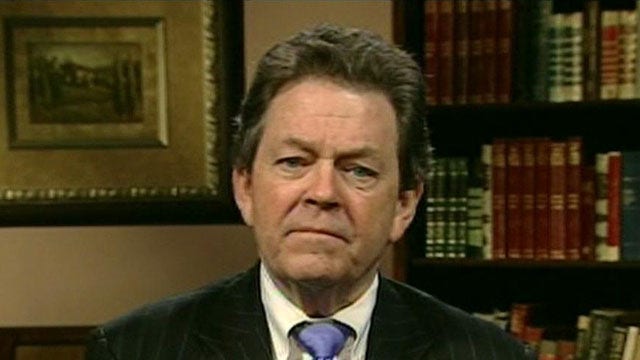
    Former Reagan economic advisor Dr. Art Laffer simplifies the spending problems of the Obama presidency thus far.

  • Duration 7:17
  • Date

Clips

Also in this playlist...

Latest Video

Auto-advance: ON

Auto-advance

Transcript

This transcript is automatically generated

But advisor doctor art Laffer art.

What do you make of these.

Yet it's viable -- the -- are we cutting -- off I mean this is this is the plate we're gonna start.

I don't think so Tom I mean you know these are threats from the president and all presidents make them whenever they get the debt ceilings.

I'm gonna cut off all the important stuff so you've got -- pay politically.

But you know you've got a tool here at the debt -- -- it's been in existence since 1939.

Brought in by Roosevelt.

It's been used by Democrats and Republicans it forces the parties to come together.

To negotiate necessarily policies going forward.

And it's a very legitimate tool and I think the president is playing his role now but you know time when he was a senator.

He was totally in favor of using the -- -- to stop George W.

Bush from spending.

So there's a little bit of hypocrisy in all of this and every party in power wants to get rid of the debt ceiling and every party out of power wants to keep -- Republican or Democrat and makes it just makes sense why so and I liken a lot by the way sort of like a game but but that's the question that's on article the other day saying that the debt ceiling is much bigger deal in the fiscal clip from an economist -- view is -- Well if -- in fact you actually did stop spending totally except for tax revenues it would be huge.

But no -- it's gonna do that Tom that's not gonna happen it's like the fiscal cliff you knew there was going to be be in agreement was gonna come in where that compromise.

Both sides had to come together they did they got a bill through.

You know it's the way government operates and they always threaten each other and that it never turns out that way and I like the debt ceiling that and they make sense -- Maybe so maybe that is the way government operates but it's an -- may be is just my short term memory problem but I'm I'm going.

I don't remembered the fights in the constant K Austin.

And then walking over to the edge of various clips that were having that we've gone -- -- the last four years.

-- not over the last four at the last four years have been exceptionally partisan politics.

It's been very contentious but if you go back to the Jimmy Carter -- or Newt Gingrich dealing with Bill Clinton we -- debt ceiling battles all over the place so.

This type of contentious this.

While pretty extreme today has been around forever Tom -- it's it's not new.

And what it does give it really brings the two sides together and forces them to consider the other person's position.

And make a compromise negotiate and come out with a better policy in the end so I think the debt ceiling is just another way of making sure government works.

To be in the interest of the general public.

Aren't there's a lot of people I don't like that that -- a lot of people are very concerned about the about the fact of the debt and about to stop the spending now sort of crowd.

Are you -- yes.

Are you -- that -- knowing I'm.

But.

Let me just say -- I do not think the debt ceiling limit should be used to stop all government spending I really don't but.

I do think it should be used to get the Democrats to reduce spending.

And I would love -- Boehner could get the debt ceiling extended for three or four months and then have another discussion another discussion.

So we gradually emerge to bring down government spending.

We have a spending problem in the United States.

And it's got to be brought under control one way or another.

The debt ceiling will allow us to gradually bring that spending under control without raising taxes are so that's only that sense I think the -- the.

Yeah left somewhere in this big fight to you over a year ago it actually impacted the economy -- consumer confidence went down there were of people slowing down on spending in the businesses were hunkering in to their bunkers.

So so the economic impact is psychological but it's there.

While they could be -- it does cause a lot of anxiety that's very true and I I wish we could solve all of our problems -- without anxiety without conflicts without.

You have cliffs and ceilings and stuff like that but we can't we've got a bipartisan government.

Which -- -- -- -- has different views of the world and the way they make policy is by negotiating compromises and battling.

And and that's worked -- served us pretty well for a couple hundred years and.

You know it it causes everyone to be stressed out -- lot but.

I think it really is a good form of government to go back and read the debates and that in in that in nineteenth century saying things were happening.

Over very silly issues from our perspective today but.

I don't think Obama should get away with all the -- the ever wants and the Democrats.

Other Republican controlled house -- control most of the governorships you know they should have a say in how much spending there isn't the debt ceiling gives the Republicans a chance to have their say.

That at this point those sixteen trillion about twenty trillion.

But I'll make him thirty -- forty trillions and I think that I had gotten -- -- on our ability to grasp it.

We have a very large debt problem and a very large spending problem and the two go hand in the end.

This period of debt ceiling is not the way to solve those problems.

You really have to get.

A one party gets control and -- government spending dramatically.

Gets a low rate flat tax puts and sound money.

Free trade minimal regulations and brings the prosperity back the way we get under Reagan the way it was done under Clinton by the way as well.

That's what's needed unfortunately we don't have that today in the US.

But -- -- -- in 20142016.

Believe me -- the opportunities for us to do a good job are just around the corner so I'm pretty excited about the US.

-- as far asks.

-- you're always great art and -- making complex economics down to something simple -- thing what is the what is the impact.

Of government going out and borrowing more and more more they have to print money or borrow money because this crowd out the private sector what is it.

Of course of course they do they crowd out the private sector they put huge burdens on future generations.

This debt problem this spending problem is very very serious it's easily solved by the way Tom.

I mean you just raised that retirement age are you make needs tests -- requirements the way we did with Social Security under Reagan.

And you know you can solve these problems but what you need to do is have a will desire to do it.

And the debt is the consequence of bad government policies did and it -- you know hurt us does that make it harder.

For me wanna go to the bank to get a loan.

That the bank court reasoned as it is and it's able to make me alone is because the government's.

Scooping up all the money.

Well yeah.

And also -- causing the economy to grow very slowly.

I mean we have the worst single recovery in US history our recovery from the last peak from last trough is worse than the next worst is from the best.

So you've got a terrible economy here with.

-- very slow growth and employment all of this stuff because of bad policies spending policies and debt policies.

We've got to solve them.

That's true and that's the weighted public you're very right the debt is a huge huge problem for the US.

And we've got to get our hands around it and I think the Republicans have a good chance here to start making some inroads in getting some control over spending.

It's not going to be the end result though but it will be this stark a bringing spending down all right art Laffer always --