This transcript is automatically generated
Thank you.
Well as Washington moves closer to the debt ceiling deadline -- next guest says the debt limit mosque being raised to avert what he calls a crisis but.
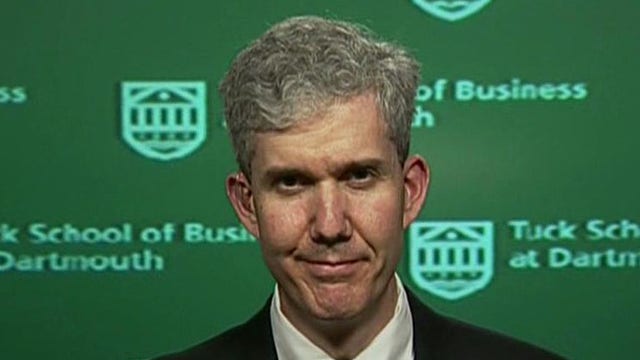
How is the uncertainty we're facing right now impacting American businesses would joining us now Matthews wolf there.
Associate dean of the tuck school of business of -- and a former member by the way.
But the council of economic advisors under President Bush.
Matthew thank you for joining us.
Simply put.
There is no option in your opinion we have to raise the debt ceiling what happens if we don't.
-- ask -- question to -- honestly no one knows the answer and I hope that we don't find out the answer.
It's not like the United States government as a small business that gets three pills -- -- and -- cash -- -- short one day they can just picture with the bills.
And millions of payments -- made by the federal government every day.
And we just don't know especially given the fragility of the economy in world capital markets.
What will happen if one day one week one month goes by with the US government is defaulting on different obligations.
You know countries of defaulted before lost their triple -- rating but have managed to turn it around them.
And recover and be able to borrowed money from the markets I mean.
Is this a wakeup call I mean god forbid we go we you know we do not raise the limit -- unable to pay out bills.
But isn't the kind of shot the may be needed to get -- spending under control.
But so that could be an outcome -- -- right there's a lot of historical evidence over the many years of of countries losing access to capital markets because of defaults.
But one important consideration is even when they regain access to capital markets at -- to take many years or decades to fully regain the confidence of international investors.
And second there's a lot of economic hardship that tends to come along the way if you look at Argentina over the past decade since their large sovereign default.
Argentine this economy today is struggling and so I think.
This still a little bit to me feel like found that classic Bill -- movie Groundhog Day here we -- yet again like we were in summer of 2001.
The same basic issues and to some extent an absence of leadership in Washington to address this issue yes we have a major fiscal problem.
That will turn into a crisis in the next generation -- spending isn't controlled.
In some systematic way but.
Reaching that point of trying to address the spending challenging and pro growth taxation.
Through the debt ceiling is a very dangerous and and kind of risky strategy I think for our country to pursue that you know Matthew -- give -- a friendly -- out or its credit cards.
It has to take action it's still hasn't but still get revenue because -- -- -- the government still gets revenue because it's getting tax is what you have to do is reallocate.
Budget and live within your means what's wrong with that.
Well one big difference -- years in my family the federal government is.
Last I checked my credit wasn't the key asset that the world -- a lot of capital markets off of in terms of being considered the risk free asset the world.
And so that's part of the on nobility of if there -- a default by the US government.
It's really hard to know what the economic impact is gonna be both in terms of capital markets what that will do and right oil holdings around the world.
And I think at least as important what might happen to the confidence of households and businesses and American and the rest of the world.
Our recovery remains pretty some very sluggish on the job creation is barely above the rate that's needed to -- sustained.
The growth in the population in the labor force.
So.
That metaphor there there's some parallel which is -- -- we haven't we have a deficit problem in debt problem in America today.
We need to start to address that somehow it would be great to have leadership.
That prevents us from going through the same kinds of things we did summer 2011.
In a way that starts to address that away because more confidence to households and businesses you know you're absolutely right we do and he some leadership there's no doubt about it Matthew -- that.
Tuck school of business -- these other -- so much for joining us.
My -- thank you thing.