You're watching...

House Passes Fiscal Cliff Legislation

Details

  • Description

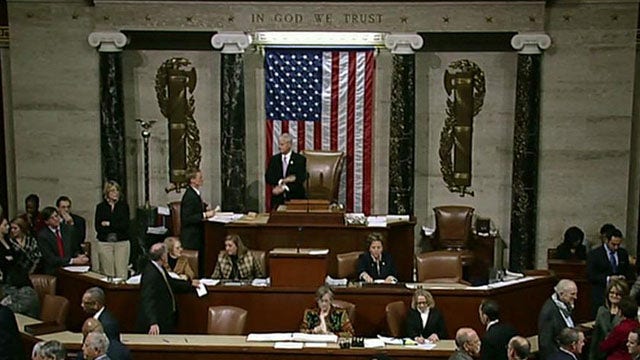
    FBN’s Peter Barnes on the passage of the fiscal cliff legislation through the Senate and Congress.

  • Duration 5:30
  • Date

Clips

Also in this playlist...

Latest Video

Auto-advance: ON

Auto-advance

Transcript

This transcript is automatically generated

-- to President Obama says he will sign the fiscal -- agreement that's have to lawmakers in the House of Representatives.

Approve the measure late last night bringing -- and the months of high stakes back and forth political theater.

For more on all of this we turn to Peter -- he joins us live this morning in Washington and -- good morning to you Peter.

Hey -- my happy new year -- year now after a day of internal fighting.

Among house Republicans and after hours of uncertainty the house gave final approval to that tax cut bill to 57 to 167.

Late last night it was carried by a 172 Democrats and just 85 Republicans.

A 151.

Republicans voted against the measure.

Many of them opposed it and demanded it be amended to include big spending cuts and set back to the senate but senate Democrats said they would not take up an amended bill with spending cuts so.

To keep it from getting killed house speaker Boehner that allow the bill to come to the floor he made no comment when he did that Republicans said they would fight for spending cuts when the president asks for another increase in the debt ceiling and the next couple of months.

This is a permanent.

Tax policy these are permanent tax provisions for putting in this bill.

And that permanently sets the baseline that permanently sets how much money.

The government can take out of the economy.

Now because of this this is the largest tax cut in American history.

And I think that's helpful because the best way.

To grow our -- -- to get out of our debt and deficit is to grow our economy.

And we can do that through comprehensive and fundamental tax reform and this is just the first step.

I am very open -- I agree with.

Democrats and Republicans that the aging population and rising cost of health care makes Medicare the biggest contributor -- our deficit.

I believe we've got to find ways to reform that program without hurting seniors who count on it to survive.

And I believe that there is further unnecessary spending and government that we can eliminate.

But we can't simply cut our way to prosperity.

Now the bill would raise taxes on people away -- -- comes individuals.

Well that -- -- income of more than 400000 dollars a year couples being comes over 450000.

Now this would allow taxes on capital gains and dividends to go up for this group of taxpayers from 15% to 20%.

But everybody it makes below those thresholds still gets the 15% tax rate on dividends and capital gains the bill would also extend unemployment benefits for another year for about two million people it would delay those automatic spending cuts the sequester.

For two months to give congress time to try to work something out on that.

But it does allow payroll taxes to rise as you know for the last two years there's been a cut in payroll taxes of about 2% but both parties decided that.

It was time to let that go back up so that we'll hit.

Pretty that -- hit everybody who works and gets a paycheck but the battle over spending began yesterday as well on that hurricane sandy.

Relief bill that sixty billion dollar bill the house did not take that up much to the consternation.

Of many members from the states from those states that work.

Hard hit by sandy -- Here there's so much to talk about here -- a lot of wanna ask you first I know that political score keepers say who won who lost but it would seem to me as you showed in sound -- we heard that the bush tax cuts are now permanent for the vast majority of us in the United States seems like a victory on that front for the Republicans.

But on the spending front we're about to add trillions to the debt of this nation did did speaker Boehner have anything to say about either of those issues.

-- out late and the evening he did put out a statement.

He talked about.

That piece about the spending piece of it.

He said the federal government has a spending problem that has led to a sixteen trillion dollar national debt that threatens our country's future.

And he's talked about trying to.

-- -- -- -- -- -- -- -- -- -- -- -- -- -- -- -- -- -- -- -- -- -- -- -- -- -- -- -- -- -- -- -- -- -- -- -- -- -- -- -- -- -- -- -- -- -- -- -- -- -- -- -- -- -- -- -- -- -- -- -- -- -- -- -- -- -- -- -- -- -- -- -- -- -- -- -- -- -- -- -- -- -- -- -- -- -- -- -- -- -- -- -- -- -- -- -- -- -- -- -- -- -- -- -- -- -- -- -- -- -- -- -- -- -- -- -- -- -- -- -- -- -- -- -- -- -- -- -- -- -- -- -- -- -- -- -- -- -- -- -- -- -- -- -- -- -- -- -- -- He would sign the bill when it hits gets to his desk.

We're we're trying to fighting somewhere -- some any report that he's actually signed the legislation but.

You know once congress does pass a bill it does take a little bit of time.

Two get it to the president he can sign it in Hawaii we presume we presume that.

That that will happen if it hasn't happened already.

Alright Peter Barnes and the team in Washington carrying us through the entire debate starting on New -- even with us right now we appreciate you being here.

Very early this -- -- thanks.