You're watching...

Does Obama Want to go Over the Fiscal Cliff?

Details

  • Description

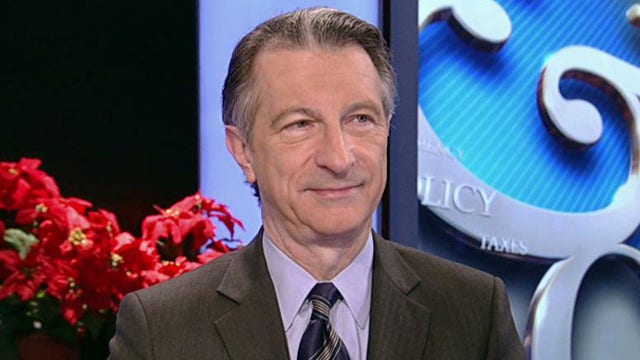
    WSJ’s Dan Henninger on President Obama’s strategy on the fiscal cliff debate.

  • Duration 4:37
  • Date

Clips

Also in this playlist...

Latest Video

Auto-advance: ON

Auto-advance

Transcript

This transcript is automatically generated

Haitian short to continue talks of some kind on the fiscal cliff joining us now is Dan Henning.

From the Wall Street Journal -- This President Obama -- want to go over.

The fiscal cliff a lot of Republicans are saying -- because of his spending increases -- increased the baseline spending a budget point 5% he needs more than what he would just yet.

From the rich get.

I doubt that he wants to grow over the cliff.

I must say President Obama has -- repeatedly referred to himself as a unique politician he's different in every what.

There are is no politician I know would want to get into a situation like this Barack Obama.

Marches to his own drummer it's just possible but I kind of doubt it.

You know you wrote a piece in the Wall Street Journal which kind of -- -- there's something wrote years ago called no guard rails you talk about how.

The old guard rails a kind of kept society in order and kept the politicians in order and -- -- social norms self restraint.

All those things have disappeared as a result of the -- generation and Obama many people say is is the epitome of the me generation press is that why it's so hard to.

Get a deal because he just sees things from his perspective -- he won't -- -- to the other perspective.

Well the original metaphor no guard -- had to do with the idea that you -- -- -- on a highway people drive 75 miles an hour but occasionally someone gets out of control -- -- too fast you don't want them going over the -- so to speak you wanna protect them.

Well that was back -- argued back in the 1960s -- what people were sitting in and universities and they have something called it non negotiable demand.

I think -- non negotiable demand.

I think that Tennessee -- -- society and people became more self righteous more self directed president understanding that we had to operate within certain rules.

I do think it has infected Washington I mean I would call President Obama -- all right just president's we have ever had.

When you have I mean the President Reagan for example stood for very concrete things he didn't he didn't bend on the principles but he was because they have those guard rails -- kind of allowed them.

It made it easier to negotiate with people that they disagreed with for example Tip O'Neill the Democrat.

Made the deal with a Republican president offer a huge change our tax structure there seems no possibility.

Of making a deal like that be made now.

Well the Republicans clearly feel that they've been disadvantaged by President Obama and that actually I don't think trust him or the Democrats anymore because the experience they went through with the Affordable Care Act obamacare.

They got nothing out of -- and so they feel they will be hung out to dry athlete if they do it.

We met -- summit pots and pans cluttering around the beltway -- change her about this -- -- what bothers me is.

The lopsided in this of the debate.

How in the GOP for decades has never stood up and said.

We are the ones delivering middle class tax cuts these are middle class tax rates are an active and George W.

Bush.

We own these middle class tax lower tax rates for the middle class not the Democrats why isn't -- -- stepping up and.

I guess because they have no historical memory but they really just will not.

Point out that it was a Democrat hasn't done this since.

-- -- -- Back in the early 1960s.

And he got to the -- approach actually Clinton lowered the capital gains steady -- -- and and because of that we had a huge -- in the stock market.

Questions for anyone you bring up that -- history that the tax cuts barely passed at the early part of 2000 why didn't they make them permanent -- that we could have avoided this kind discussion.

And elections.

Tax were -- tax.

Policy is extremely difficult they put it through the so called reconciliation.

Process which doesn't require sixty votes.

Reconciliation laws sunset after ten years they're not permanent and that's why this one is sun setting.

Rather than having done a you know -- long term tax reform bill quite -- or at very -- why can't we get sun setting on spending.

And and no sun setting on tax cuts I mean we should be -- we.

That's what we should be sun setting of these spending bills we're going to be talking about wind energy which needs besides that -- soon you bring up the side of the clip that currently anyone talks about which is the sequester the automatic spending reductions.

I don't think it would be a bad thing if Washington took the sequester and showed that this country could actually truly cut spending -- We never -- we have -- never budget balancing act going on.

With as the journalist pointed out secret gang of six meetings that's budgeting by secret gang of twelve meetings.

What do you think about how quickly quickly politicians.

That's what we used to call blue smoke and mirrors in Washington and that's why people are so upset at Washington they don't trust that Dan had -- good to see you again you guys very much for that now.